Energy can be extracted from natural resources in many forms, and it can be transferred from one body to another in form of heat or work.
Types of Energy
Some different types of energies are:
Mechanical energy
Chemical energy
Thermal energy
Nuclear energy
Solar energy
Wind energy
Sound energy
Electrical energy
Energy Conversion from One Form to Another
Energy can neither be created nor be destroyed but it can be transformed from one form to another.
Eg: In Microphone: Sound energy is converted to electrical energy.
Natural Resources
Natural resources are the resources that are provided by the earth. Two types:
Inexhaustible/Renewable natural resources are present in unlimited quantity in nature. Eg: Sunlight, wind.
Exhaustible/Non-Renewable natural resources are present in limited quantity in nature. Eg: Coal, petroleum.
Fossil Fuels
Fossil fuels are the exhaustible resources that are formed from the decomposition of dead organic matter. Eg: Coal, Natural gas
Energy Stored in Fossil Fuels
Energy stored in fossil fuels are derived from decayed animals and plants that exist for millions of years.
Energy Utilisation from Fossil Fuels
40% energy used by the industries
24% energy used by the Transportation sector
6% energy used by farms
30% energy used for domestic and other purposes.
Coal Formation
Coal
Coal is a black coloured fossil fuel, which is extracted from the ground and is used as a fuel for different purposes.
Peat
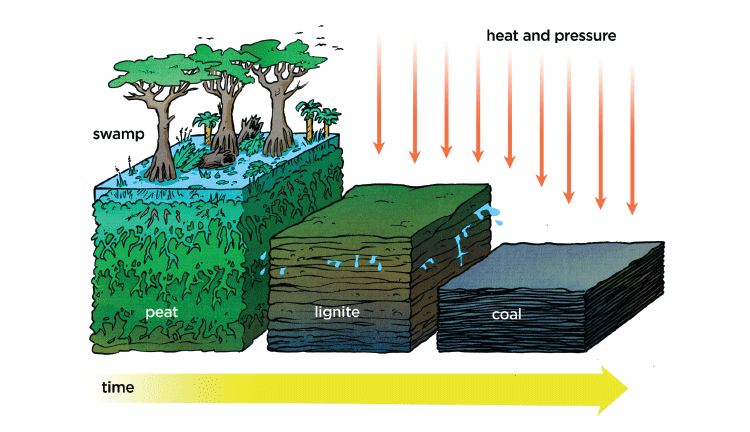
Peat is a dark fibrous fuel composes of partly decomposed plant matter. It is the first stage in the formation of coal.
Formation of Coal
Under high pressure and temperature, the dead vegetation gets converted into coal. This process is called as carbonisation.
Types of Coal
Types of Coal
There are 4 types of coals:
Anthracite
Bituminous
Sub-bituminous
Lignite
Destructive Distillation of Coal
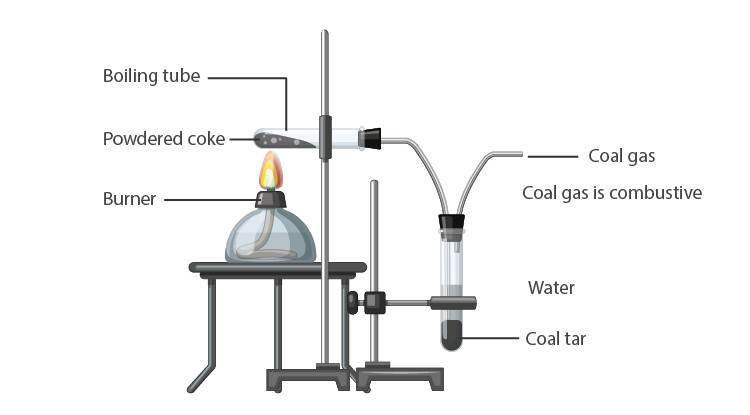
Destructive distillation of coal is the process of heating of coal in the absence of air. By-products formed in this process are coke, coal tar, ammonia, coal gas.
Coal Tar
Coal tar is a black thick liquid with an unpleasant smell and used as a starting material for manufacturing various substances.
Coal Gas
Coal gas is a fuel produced during the destructive distillation of coal. It is used as a fuel in many industries.
Ammonia Liquor
Ammonia liquor or ammonium hydroxide is one of the by-products formed during the destructive distillation of coal. It is used to make fertilizers.
Coke
Coke is a black coloured substance and pure form of carbon used for manufacturing steel and extraction of metals.
Extraction of Oil
Oil Wells and Reservoirs
An oil well is used to bring the oil or other hydrocarbons to the surface. It is a long hole created into the earth.
An oil reservoir is the underground lake of oil composed of hydrocarbons.
Extraction of Oils
Extraction of oil is the process by which usable oil is extracted from the earth’s surface location.
Determining the Characteristics of Oil Reservoirs
Characteristics of oil reservoir are:
Devices like geophones are used to determine the presence of oil in rocks by identifying the reflected sound waves.
Exploratory wells are used to extract oil samples.
Primary Production of Oil
The natural flow of oil is called as the primary production of the oil. It can persist for days or years.
Secondary Recovery Process
The secondary process can be carried out by the process of:
water flooding
injecting chemicals into the reservoir.
injecting carbon dioxide into the reservoir.
microbially enhanced oil recovery
Fractional Distillation
Crude Oil
Crude oil is a type of fossil fuel, which is an unrefined petroleum product composed of hydrocarbons.
Boiling Point and Vaporisation
The boiling point is the temperature when the pressure exerted by surroundings on liquid & pressure of liquid becomes equal.
Vaporisation is the process of changing the state from liquid to gas.
Oil Refining or Fractional Distillation
Oil refining or fractional distillation is the process of separating liquids with different boiling points at different temperatures using fractional columns.
Uses of Products Obtained in Fractional Distillation
Products and its uses:
LPG: Fuel for home and industry
Petrol and diesel: Motor and aviation fuel
Kerosene: Fuel for stoves and lamps
Lubricating oil: Lubrication
Bitumen: Used to make paints
Paraffin wax: Used to make ointments, candles
Shortage of Petroleum and Tips for Its Conservation
Petroleum should be carefully used to avoid its shortage.
PCRA proposed some methods to save petrol and diesel like driving vehicles at constant speed.
Natural Gas
Hazards and Estimates of Fossil Fuels
Hazards caused due to excessive use of fossil fuels:
Air pollution
Global warming
Estimates of fossil fuel:
Coal may persist for another century and petroleum for another 40 years.
Natural Gas
Natural gas is a colourless, odourless fossil fuel, which is transported through pipes from one place to another.
Cng and Its Advantages
Natural gas stored under high pressure is known as CNG. Advantages of CNG are:
It’s a Cleaner fuel
It’s less polluting
It can be used directly for burning.
Occurrences of Natural Gas in India
Natural gas are found in parts of Tripura, Rajasthan, Maharashtra, Tamilnadu, Andhra Pradesh.
Everything around us is categorized into either metals or non-metals. Hence, it is important to know what non-metals and metals are and how to distinguish them. The class 8 science chapter 4 discusses the various physical and chemical properties of metals and non-metals. To help you with it, here we list a few physical and chemical properties of metals and non-metals.
Metals
Metals are described as chemical elements that readily lose valence electrons to form positive ions (cations). Examples: Aluminium, copper, iron, tin, gold.
Around 90 of the total 118 elements are metals.
Physical Properties
Physical Properties of Nonmetals
Occur as solids, liquids, and gases at room temperature
Brittle
Non-malleable
Non-ductile
Non-sonorous
Bad conductors of heat and electricity
Exceptions in Physical Properties
Alkali metals (Na, K, Li) can be cut using a knife.
Mercury is a liquid metal.
Lead and mercury are poor conductors of heat.
Mercury expands significantly for the slightest change in temperature.
Gallium and cesium have a very low melting point
Iodine is non-metal but it has lustre.
Graphite conducts electricity.
Diamond conducts heat and has a very high melting point.
Physical Properties of Metals
● Hard and have a high tensile strength ● Solids at room temperature, except mercury, which is liquid at room temperature. ● Sonorous ● Good conductors of heat and electricity ● Malleable, i.e., can be beaten into thin sheets ● Ductile, i.e., can be drawn into thin wires ● High melting and boiling points (except Cesium (Cs) and Gallium (Ga)) ● Dense, (except alkali metals). Osmium – highest density and lithium – least density ● Lustrous ● Silver-grey in colour, (except gold and copper)
Non-Metals
Non-metals are those elements, which do not exhibit the properties of metals. Examples: Carbon, Boron etc.
Chemical Properties of Metals
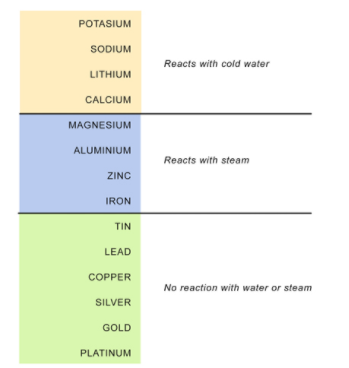
● Alkali metals (Li, Na, K, etc) react vigorously with water and oxygen or air. ● Mg reacts with hot water. ● Al, Fe, and Zn react with steam. ● Cu, Ag, Pt, Au do not react with water or dilute acids.
Chemical Properties
Displacement Reactions
A more reactive element displaces a less reactive element from its compound or solution. i) Zn(s)+CuSO4(aq)→ZnSO4(aq)+Cu(s) ii) 2Al(s)+Fe2O3(molten)→Al2O3(s)+2Fe(molten)
Metals Reaction with Oxygen (Burnt in Air)
Metal + Oxygen → Metal oxide (basic) ● Na and K are kept immersed in kerosene oil as they react vigorously with air and catch fire. 4K(s)+O2(g)→2K2O(s) (vigorous reaction) ● Mg, Al, Zn, Pb react slowly with air and form a protective layer that prevents corrosion. 2Mg(s)+O2(g)→2MgO(s) (Mg burns with a white dazzling light) 4Al(s)+3O2(g)→2Al2O3(s) ● Silver, platinum, and gold don’t burn or react with air.
Basic Oxides of Metals
Some metallic oxides get dissolved in water and form alkalis. Their aqueous solution turns red litmus blue.
Na2O(s)+H2O(l)→2NaOH(aq) K2O(s)+H2O(l)→2KOH(aq)
Amphoteric Oxides of Metals
Amphoteric oxides are metal oxides which react with both acids as well as bases to form salt and water. For example – Al2O3,ZnO,PbO,SnO Al2O3(s)+6HCl(aq)→2AlCl3(aq)+3H2O(l) Al2O3(s)+2NaOH(aq)→2NaAlO2(aq)+H2O(l) ZnO(s)+2HCl(aq)→ZnCl2(aq)+H2O(l) ZnO(s)+2NaOH(aq)→Na2ZnO2(aq)+H2O(l)
Reactivity Series
The below table illustrates the reactivity of metals from high order to low order.
Metals, which are less reactive than hydrogen cannot displace hydrogen from its acids and hence no reaction takes place.
How Do Metals React with Solution of Other Metal Salts
High reactive metal displaces the low reactive metal from its salt solution.
MetalA+SaltofmetalB→SaltofmetalA+MetalB
Fe(s)+CuSO4(aq)→FeSO4(aq)+Cu(s)
Reaction of Metals with Bases
Base+metal→salt+hydrogen 2NaOH(aq)+Zn(s)→Na2ZnO2(aq)+H2(g), when zinc reacts with aqueous sodium hydroxide it gives sodium zincate and hydrogen gas.
The Why Questions
Electronic Configuration
Electron configuration is the distribution of electrons of an atom or molecule in atomic or molecular orbitals.
Group 1 elements – Alkali metals
Element
Electronic configuration
Lithium (Li)
2,1
Sodium (Na)
2,8,1
Potassium (K)
2,8,8,1
Rubidium (Rb)
2,8,18,8,1
Group 2 elements – Alkaline earth metals
Element
Electronic configuration
Beryllium (Be)
2,2
Magnesium (Mg)
2,8,2
Calcium (Ca)
2,8,8,2
Stronium (Sr)
2,8,18,8,2
How Do Metals and Non-metals React
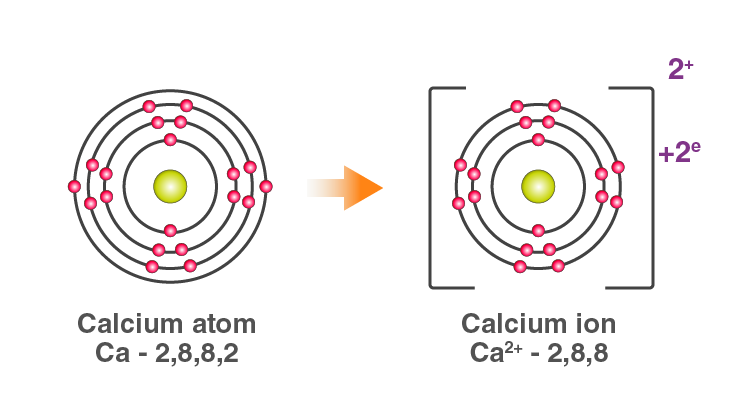
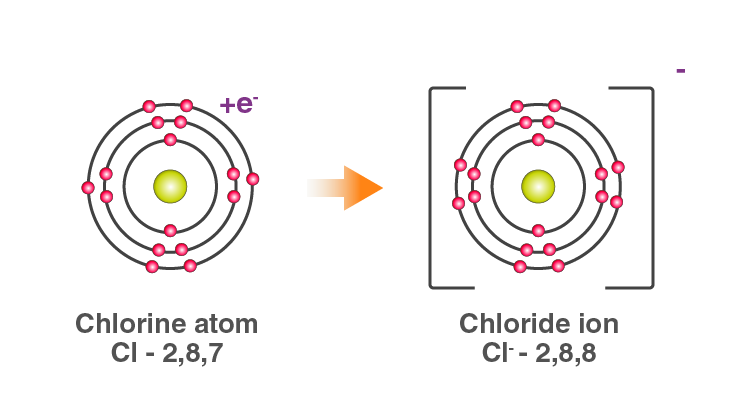
Metals lose valence electron(s) and form cations. Non-metals gain those electrons in their valence shell and form anions. The cation and the anion are attracted to each other by strong electrostatic force, thus forming an ionic bond. For example: In Calcium chloride, the ionic bond is formed by oppositely charged calcium and chloride ions. Calcium atom loses 2 electrons and attains the electronic configuration of the nearest noble gas (Ar). By doing so, it gains a net charge of +2.
The two Chlorine atoms take one electron each, thus gaining a charge of -1 (each) and attain the electronic configuration of the nearest noble gas (Ar).
Ionic Compounds
Ionic compounds are chemical compounds in which oppositely charged ions are held together by electrostatic forces called ionic bonds.
An ionic compound always contains an equal magnitude of positive and negative charges. For example: CaCl2, NaCl, K2SO4, etc
Properties of Ionic Compounds
Are usually crystalline solids (made of ions).
Have high melting and boiling points.
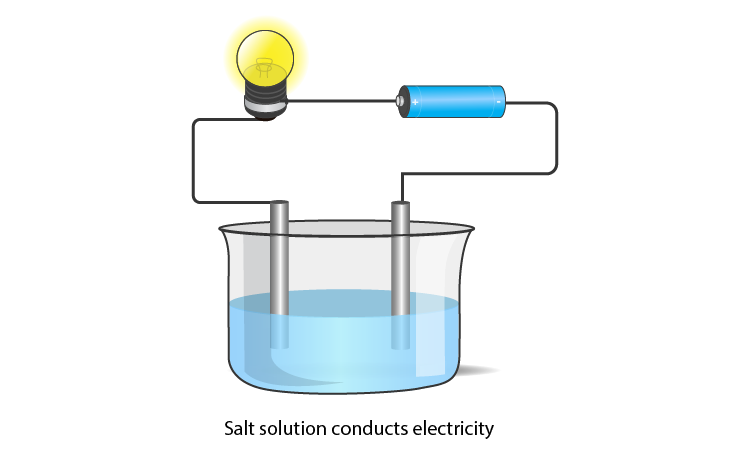
Conduct electricity when in aqueous solution or molten in water and when melted.
Are mostly soluble in water and polar solvents.
Physical Properties of Ionic Compounds
Ionic compounds are solids and are hard to break, due to the presence of the strong force of attraction between the positive and negative ions.
They generally break into pieces when pressure is applied, hence are considered brittle.
Lattice Structure of Ionic Compounds
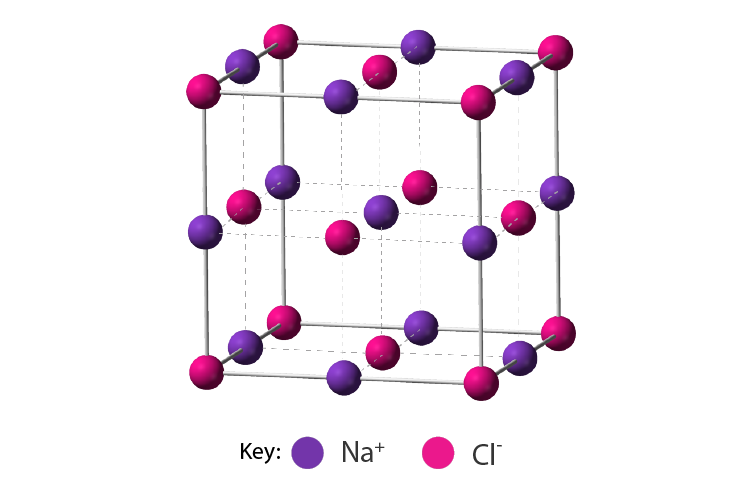
A lattice is a regular arrangement of particles, whether these are atoms, ions or molecules.
Ionic solids usually exist in regular, well-defined crystal structures.
Electric Conduction of Ionic Compounds
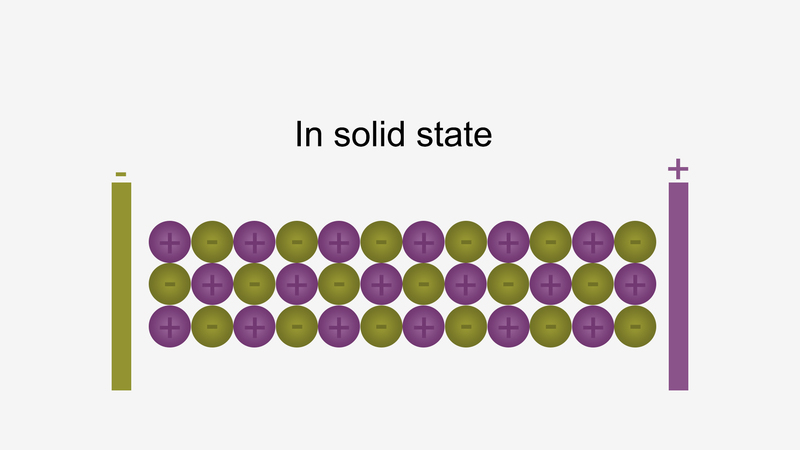
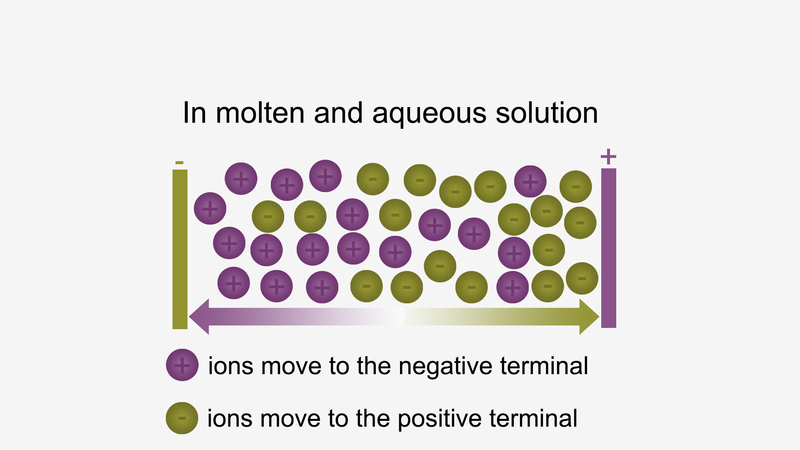
Ionic compounds conduct electricity in the molten or aqueous state when ions become free and act as charge carriers. In solid form, ions are strongly held by electrostatic forces of attractions and not free to move; hence do not conduct electricity.
For example, ionic compounds such as NaCl does not conduct electricity when solid conduct electricity but when dissolved in water or in molten state, it will conductelectricity.
Melting and Boiling Points of Ionic Compounds
In ionic compounds, the strong electrostatic forces between ions require a high amount of energy to break. Thus, the melting point and boiling point of an ionic compound are usually very high.
Solubility of Ionic Compound
Ionic compounds are generally soluble in polar solvents such as water ,whereas the solubility tends to decrease in non-polar solvents such as chloroform, oil, etc.
Extraction of Metals and Non-Metals
Applications of Metals and Non-metals
Zinc is used to protect the iron from rusting.
Gold and silver are used for making jewellery.
Oxygen is used by plants and animals.
For the preparation of ammonia, nitric acid and fertilizers, nitrogen is used.
For the purification of water, chlorine is used.
Diamonds are used for cutting glass in different industries.
Occurrence of Metals
Most of the elements especially metals occur in nature in the combined state with other elements. All these compounds of metals are known as minerals. But out of them, only a few are viable sources of that metal. Such sources are called ores. Au, Pt – exist in the native or free state.
Extraction of Metals
Roasting
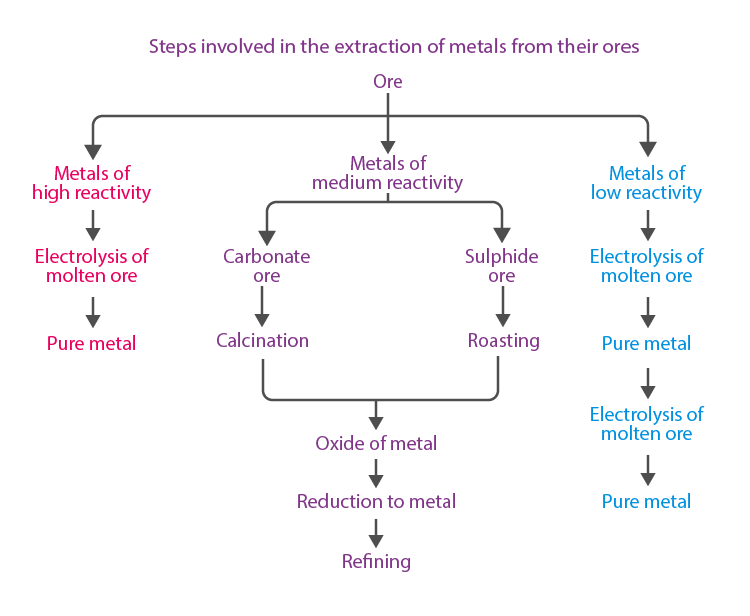
Roasting:- Converts sulfide ores into metal oxides on heating strongly in the presence of excess air. It also removes volatile impurities. 2ZnS(s)+3O2(g)+Heat→2ZnO(s)+2SO2(g)
Calcination
Calcination: Converts carbonate and hydrated ores into oxides on heating strongly in the presence of limited air. It also removes volatile impurities.
Extraction of Metals, Which Are Lower in the Reactivity Series
The metals like gold, silver, platinum, and copper are the least reactive and found in free state.
Copper and silver are also found in the combined state as their sulphide or oxide ores. These metals usually occur as sulphide ores, which further undergo roasting.
Extraction of Metals, Which Are Mid-Way in the Reactivity Series
The metals such as Zn, Fe, Pb, etc are moderately reactive and usually present as oxides, sulphides or carbonates in nature.
The carbonate and sulphide ores are subjected to calcination and roasting respectively, followed by reduction of metal oxides to obtain the metals.
Extraction of Metals, Which Are on the Top of the Reactivity Series
Na, Ca, Mg, Al, etc., cannot be obtained by reducing with C due to high affinity for oxygen.
These metals are obtained by electrolytic reduction or electrolysis of their oxides, hydroxides or chlorides in the molten state.
Enrichment of Ores
It means removal of impurities or gangue from ore, through various physical and chemical processes. The technique used for a particular ore depends on the difference in the properties of the ore and the gangue.
Refining of Metals
Refining of metals – removing impurities or gangue from crude metal. It is the last step in metallurgy and is based on the difference between the properties of metal and the gangue.
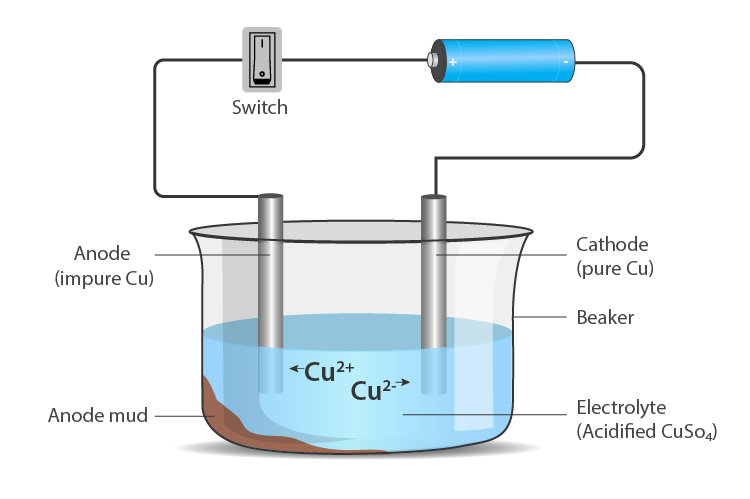
Electrolytic Refining
The process of purifying impure metal to obtain pure metal on the passage of electric current is called electrolytic refining.
Metals like copper, zinc, nickel, silver, tin, gold etc., are refined electrolytically. Anode – impure or crude metal Cathode – a thin strip of pure metal Electrolyte – aqueous solution of a metal salt From anode (oxidation) – metal ions are released into the solution At cathode (reduction) – equivalent amount of metal from solution is deposited Impurities deposit at the bottom of the anode.